What is a V60? A guide to the pour-over method What is a V60? A guide to the pour-over method Did you know
Did you know

What is a V60? A guide to the pour-over method

Will Sowerby

Written by Will Sowerby / Views

Published - 29 September 2026

Key takeaways

  • A V60 is a cone-shaped pour-over dripper that you brew coffee with by hand, one cup at a time.
  • It’s made by Hario, a Japanese glassware company that launched the V60 in 2004.
  • The name is just a description of the shape – the ‘V’ is the cone, and the ‘60’ is its 60-degree angle.
  • Hot water passes down through ground coffee and a paper filter, which gives you a clean, bright cup.
  • It’s brilliant at showing off delicate, fruity flavours, so it suits lighter single-origin coffee especially well.

What is a V60?

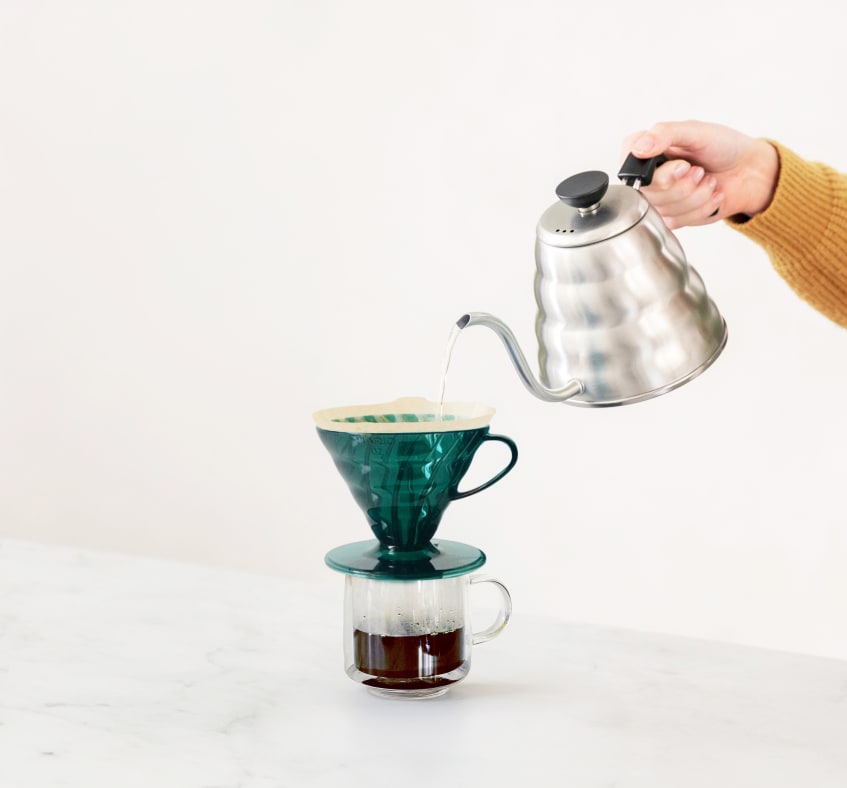
A V60 is a pour-over coffee dripper – a cone-shaped device that sits on top of your mug or a jug. You drop a paper filter inside, add your ground coffee, and pour hot water over it in stages.

Gravity does the rest, pulling the water down through the grounds so it drips out as brewed coffee into the cup below.

It’s a manual way to brew, with no electricity and no moving parts. That’s part of the appeal. What you get in the cup comes down to a handful of things you control by hand: the grind size, the water temperature, how quickly you pour, and a bit of practice.

Because the water passes through the coffee rather than sitting and steeping in it, a V60 tends to make a cleaner, clearer cup than something like a cafetière.

Pour-over is one of the most popular ways to brew coffee at home, and the V60 is probably the best-known pour-over brewer of the lot.

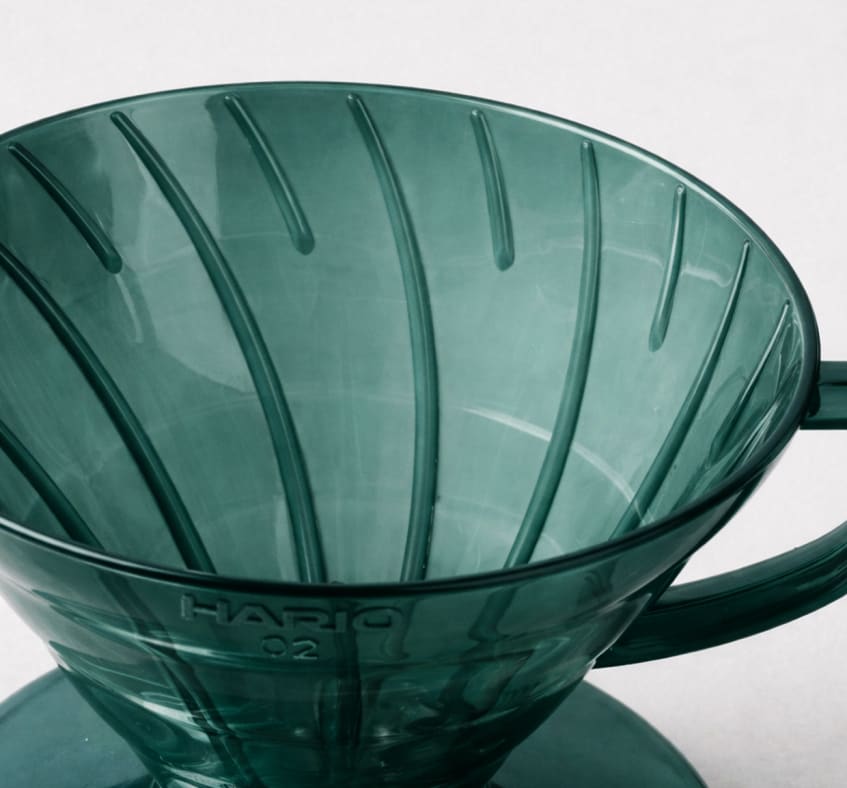
The Pact x Hario clear teal V60

Why is it called a V60?

The name looks a bit cryptic, but it’s simply a description of the design.

The ‘V’ is the cone. Looked at from the side, the dripper forms the shape of the letter V. The ‘60’ is the angle of that cone – 60 degrees.

Hario settled on this angle after testing, because it moves water toward the centre of the coffee bed at the right pace.

Steep enough and the water keeps moving through the grounds. Shallow enough and it doesn’t rush straight through.

Two other details do a lot of quiet work inside the cone. The spiral ribs along the inner wall stop the paper filter from sticking flat, which lets air escape and helps the coffee bloom and expand properly.

And there’s a single large hole at the base, so the flow is set by how you pour rather than by the dripper itself. That’s what gives a V60 its reputation for control.

How does a V60 work?

The method is straightforward once you’ve done it a couple of times. Rinse the paper filter with hot water first – this washes away any papery taste and warms the brewer.

Add your ground coffee, then pour just enough water (aim for 60ml) to wet all the grounds and let them bloom for a moment. After that, you pour the rest in slow, steady circles, keeping to the centre and easing off near the edges.

The whole brew usually takes two or three minutes, start to finish. A medium-fine grind – roughly the texture of sea salt – tends to work best.

Too fine and the water drains slowly and can turn bitter. Too coarse and it rushes through thin and sour.

Watch our V60 brew guide.

Brewing with the V60

What does V60 coffee taste like?

Clean and bright is the short answer.

A paper filter catches most of the oils and the finest particles, so what lands in your cup is clear and delicate – some people describe it as almost tea-like.

Because there’s less to get in the way, the flavours in the coffee come through more distinctly. You’ll notice the acidity and the aromatics – the floral and fruity notes – far more than you would from a fuller, heavier brew.

It’s a method that rewards a well-made coffee. There’s nowhere for a flat or over-roasted bean to hide, which is why so many speciality drinkers reach for a V60 when they want to taste what a coffee really has to offer.

What coffee works best in a V60?

Lighter roasts and single-origin coffees are where a V60 comes into its own.

We roast on the lighter side at Pact to keep the natural character of each coffee intact, rather than roasting it away.

A V60 draws out precisely those qualities – the brightness, the sweetness, and the more delicate notes that a grower has spent a whole season working towards.

When you brew a lighter single-origin this way, you’re tasting the care that went into growing and processing it.

Put simply, the clarity a V60 gives you is the clearest window onto a grower’s skill.

How is a V60 different from a cafetière or an AeroPress?

They’re different tools for different cups, rather than better or worse than one another.

A cafetière – also known as a French press – works by immersion. The grounds steep in hot water, then you press a metal mesh down to separate them.

That mesh lets the oils through, so you get a fuller, heavier cup with more body. It’s forgiving and about as simple as brewing gets.

A V60 filters instead of steeping. The paper takes out the oils and fines, so the cup is cleaner and brighter, with more of the coffee’s finer flavours on show.

You get more control over the result, but it does ask for a little more attention while you pour.

An AeroPress sits somewhere in between. It uses a paper filter like the V60, but it adds a short steep and a little pressure.

That makes it quick and forgiving, and a popular choice for travelling. It brews a smaller, concentrated cup.

FAQs

What does V60 stand for?

It isn’t an acronym. The ‘V’ is the cone shape of the dripper, and the ‘60’ is the 60-degree angle of that cone. The name is just a description of the design.

Do you need a special filter for a V60?

Yes – V60 filters are cone-shaped to match the dripper, and they come in sizes 01 and 02 for different volumes. Paper is the standard choice, though reusable metal and cloth filters exist and will give you a slightly heavier cup. Whichever you use, rinse a paper filter with hot water before you brew.

Is V60 the same as pour-over?

A V60 is a type of pour-over. Pour-over is the broad method – hot water poured over ground coffee through a filter – and the V60 is Hario’s particular cone-shaped take on it.

What grind size does a V60 need?

Medium-fine, roughly like sea salt. If the brew drains too slowly and tastes bitter, go a touch coarser. If it races through and tastes thin or sour, grind a little finer.

Is a V60 better than a cafetière?

Neither is better – they make different cups. A V60 gives you a cleaner, brighter coffee with more delicate flavour, while a cafetière gives you a fuller, heavier one. It comes down to the cup you prefer.

Want to taste the difference?

A V60 is one of the best ways to taste everything a lighter single-origin coffee has to give – all that brightness and clarity, cup after cup.

If you’d like to try it, pick a single-origin you’re curious about and brew it slowly through a V60. And if you haven’t got the brewer yet, we stock it here.

What is a V60? A guide to the pour-over method

Will Sowerby

Written by Will Sowerby

Views

Published - 29 September 2026

Key takeaways

  • A V60 is a cone-shaped pour-over dripper that you brew coffee with by hand, one cup at a time.
  • It’s made by Hario, a Japanese glassware company that launched the V60 in 2004.
  • The name is just a description of the shape – the ‘V’ is the cone, and the ‘60’ is its 60-degree angle.
  • Hot water passes down through ground coffee and a paper filter, which gives you a clean, bright cup.
  • It’s brilliant at showing off delicate, fruity flavours, so it suits lighter single-origin coffee especially well.

What is a V60?

A V60 is a pour-over coffee dripper – a cone-shaped device that sits on top of your mug or a jug. You drop a paper filter inside, add your ground coffee, and pour hot water over it in stages.

Gravity does the rest, pulling the water down through the grounds so it drips out as brewed coffee into the cup below.

It’s a manual way to brew, with no electricity and no moving parts. That’s part of the appeal. What you get in the cup comes down to a handful of things you control by hand: the grind size, the water temperature, how quickly you pour, and a bit of practice.

Because the water passes through the coffee rather than sitting and steeping in it, a V60 tends to make a cleaner, clearer cup than something like a cafetière.

Pour-over is one of the most popular ways to brew coffee at home, and the V60 is probably the best-known pour-over brewer of the lot.

The Pact x Hario clear teal V60

Why is it called a V60?

The name looks a bit cryptic, but it’s simply a description of the design.

The ‘V’ is the cone. Looked at from the side, the dripper forms the shape of the letter V. The ‘60’ is the angle of that cone – 60 degrees.

Hario settled on this angle after testing, because it moves water toward the centre of the coffee bed at the right pace.

Steep enough and the water keeps moving through the grounds. Shallow enough and it doesn’t rush straight through.

Two other details do a lot of quiet work inside the cone. The spiral ribs along the inner wall stop the paper filter from sticking flat, which lets air escape and helps the coffee bloom and expand properly.

And there’s a single large hole at the base, so the flow is set by how you pour rather than by the dripper itself. That’s what gives a V60 its reputation for control.

How does a V60 work?

The method is straightforward once you’ve done it a couple of times. Rinse the paper filter with hot water first – this washes away any papery taste and warms the brewer.

Add your ground coffee, then pour just enough water (aim for 60ml) to wet all the grounds and let them bloom for a moment. After that, you pour the rest in slow, steady circles, keeping to the centre and easing off near the edges.

The whole brew usually takes two or three minutes, start to finish. A medium-fine grind – roughly the texture of sea salt – tends to work best.

Too fine and the water drains slowly and can turn bitter. Too coarse and it rushes through thin and sour.

Watch our V60 brew guide.

Brewing with the V60

What does V60 coffee taste like?

Clean and bright is the short answer.

A paper filter catches most of the oils and the finest particles, so what lands in your cup is clear and delicate – some people describe it as almost tea-like.

Because there’s less to get in the way, the flavours in the coffee come through more distinctly. You’ll notice the acidity and the aromatics – the floral and fruity notes – far more than you would from a fuller, heavier brew.

It’s a method that rewards a well-made coffee. There’s nowhere for a flat or over-roasted bean to hide, which is why so many speciality drinkers reach for a V60 when they want to taste what a coffee really has to offer.

What coffee works best in a V60?

Lighter roasts and single-origin coffees are where a V60 comes into its own.

We roast on the lighter side at Pact to keep the natural character of each coffee intact, rather than roasting it away.

A V60 draws out precisely those qualities – the brightness, the sweetness, and the more delicate notes that a grower has spent a whole season working towards.

When you brew a lighter single-origin this way, you’re tasting the care that went into growing and processing it.

Put simply, the clarity a V60 gives you is the clearest window onto a grower’s skill.

How is a V60 different from a cafetière or an AeroPress?

They’re different tools for different cups, rather than better or worse than one another.

A cafetière – also known as a French press – works by immersion. The grounds steep in hot water, then you press a metal mesh down to separate them.

That mesh lets the oils through, so you get a fuller, heavier cup with more body. It’s forgiving and about as simple as brewing gets.

A V60 filters instead of steeping. The paper takes out the oils and fines, so the cup is cleaner and brighter, with more of the coffee’s finer flavours on show.

You get more control over the result, but it does ask for a little more attention while you pour.

An AeroPress sits somewhere in between. It uses a paper filter like the V60, but it adds a short steep and a little pressure.

That makes it quick and forgiving, and a popular choice for travelling. It brews a smaller, concentrated cup.

FAQs

What does V60 stand for?

It isn’t an acronym. The ‘V’ is the cone shape of the dripper, and the ‘60’ is the 60-degree angle of that cone. The name is just a description of the design.

Do you need a special filter for a V60?

Yes – V60 filters are cone-shaped to match the dripper, and they come in sizes 01 and 02 for different volumes. Paper is the standard choice, though reusable metal and cloth filters exist and will give you a slightly heavier cup. Whichever you use, rinse a paper filter with hot water before you brew.

Is V60 the same as pour-over?

A V60 is a type of pour-over. Pour-over is the broad method – hot water poured over ground coffee through a filter – and the V60 is Hario’s particular cone-shaped take on it.

What grind size does a V60 need?

Medium-fine, roughly like sea salt. If the brew drains too slowly and tastes bitter, go a touch coarser. If it races through and tastes thin or sour, grind a little finer.

Is a V60 better than a cafetière?

Neither is better – they make different cups. A V60 gives you a cleaner, brighter coffee with more delicate flavour, while a cafetière gives you a fuller, heavier one. It comes down to the cup you prefer.

Want to taste the difference?

A V60 is one of the best ways to taste everything a lighter single-origin coffee has to give – all that brightness and clarity, cup after cup.

If you’d like to try it, pick a single-origin you’re curious about and brew it slowly through a V60. And if you haven’t got the brewer yet, we stock it here.