What coffee bag size is right for me? What coffee bag size is right for me? Did you know
Did you know

What coffee bag size is right for me?

Will

Written by Will / Views

Published - 20 April 2026

Key takeaways

  • A 250g bag of coffee beans makes up to 16 cups. It’s the ideal size for trying a new roast, origin, or brewing method without committing to a larger bag.
  • At Pact, 250g is the entry point into our speciality coffee: freshly roasted, directly sourced, and scored 84 points or above by professional tasters.
  • If you drink one or two cups a day, a 250g bag lasts around one to two weeks – well within the four-week optimal-freshness window.
  • Once you’ve found a coffee you love, a 500g or 1kg bag offers better value and fewer deliveries.

There’s a particular pleasure in opening a bag of coffee you’ve never tried before. The moment the seal breaks, before you’ve ground a single bean or boiled a drop of water, you get your first impression. 

That could be a waft of something dark and chocolatey, bright and fruity, or warm and nutty, depending on where the beans came from and how they were processed.

That first impression is what the 250g bag is built for.

It’s the size that invites exploration. Small enough to try without hesitation, but large enough to get a proper sense of a coffee – to taste it across a few different mornings, in different moods, maybe through different brew methods. 

And when you finish it, you’re free to try something completely different, or to go back and order more of the same in a larger bag now that you know you love it.

If you’re new to speciality coffee, or if you’re the kind of drinker who likes to keep things interesting, the 250g bag is where to start.

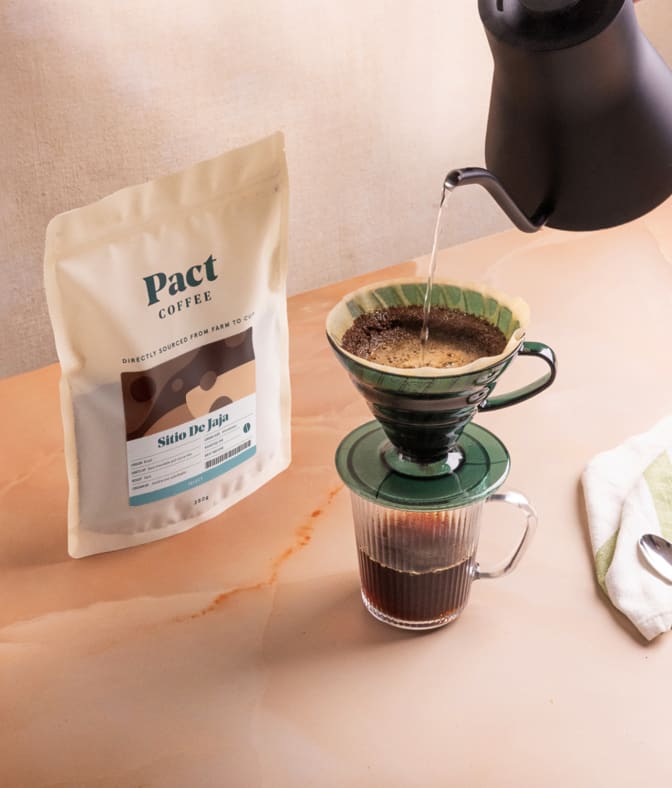
A 250g bag of Sitio de Jaja, grown by Jaceline and Julia Basilio in Brazil

How many coffees does 250g of coffee beans make?

A 250g bag of Pact coffee beans makes up to 16 cups, based on a standard 15g dose per cup.

Sixteen cups is a useful number to hold in mind. It’s roughly eight mornings of two cups, or 16 mornings of one. 

It’s enough to get a real feel for a coffee – to taste how it changes as you dial in your grinder, to notice how it drinks differently as a filter versus a cafetière, to catch those tasting notes that aren’t always obvious on the first cup but become unmistakable by the fifth.

As with any bag, the exact number will shift depending on how you brew.

Espresso

At 15g to 18g per double shot, a 250g bag gives you between 14 and 16 double espressos.

The 250g size is particularly well suited to trying a new espresso profile – you can pull a few test shots while you dial in your grinder, taste the coffee properly across several days, and decide whether you want to order more before committing to a larger bag.

Filter/pour-over

A 15g dose per cup gives you the full 16 cups.

Filter methods tend to be more forgiving than espresso when it comes to extraction, which makes a 250g bag a good companion for anyone learning the V60 or AeroPress for the first time.

You have enough coffee to experiment without the pressure of rationing a small sample.

Cafetière

At 15g per person, a 250g bag gives a solo drinker roughly 16 cups, or a couple around eight shared brews.

A slow Sunday morning cafetière is one of the most accessible ways to get to know a new coffee –the immersion method is generous with flavour.

A 250g bag of La Moneda Honey Geisha, made by Jally Fabián Téllez in Colombia

How long does 250g of coffee beans last?

How long your 250g bag lasts depends entirely on how much your household drinks. Here’s a rough guide:

  • One cup a day: your bag will last around two weeks.
  • Two cups a day: you’ll reach the bottom in about eight days.
  • Four cups a day: a 250g bag will last you roughly four days.

For most people buying a 250g bag, the intention is to try something new rather than to stock up – and the size suits that purpose well. 

You’ll move through it at a natural pace, finishing it comfortably within the four-week freshness window that we recommend for all Pact coffee.

Roasted coffee is at its most expressive in the weeks immediately after roasting. The aromatic oils that carry those tasting notes – the chocolate, the stone fruit, the caramel, and anything else the grower’s particular beans and processing method have produced — are most vivid early on, and gradually fade as oxidation sets in. 

A 250g bag, drunk at a standard pace (two-to-four weeks), means you’re tasting the coffee as it’s meant to be tasted, without any of it sitting around long enough to go flat.

This is also why we roast to order at our Surrey roastery and dispatch directly to you. The beans that arrive in your 250g bag have been roasted just days before, packed by hand, and sent out while they’re still at their best. 

Unlike commodity-grade coffee, there’s no warehouse, no shelf time, and no guessing how long the bag has been sitting under fluorescent lighting before it reached your kitchen.

A 250g bag of Los Nogales Origins, a limited edition made by Oscar Hernández in Colombia.

How to choose between 250g, 500g, and 1kg

The right bag size depends on how you drink, how adventurous you feel, and how often you want to reorder.

Choose 250g if you’re exploring, are new to speciality coffee, or want to try a few different origins and roast profiles before settling on a favourite. 

This size is also ideal if you’ve heard about a particular coffee, like an Ethiopian natural, a Colombian washed, or a Guatemalan honey-processed, and you want to taste it before committing to more. 

If you like variety and the idea of a different coffee every couple of weeks appeals to you, the 250g bag is your tasting menu.

Choose 500g if you’ve found a coffee you love and you want to drink it often, at a lower price per cup, without running out too quickly. 

The 500g bag is the sweet spot for solo drinkers and couples who have a settled morning routine and want to stop running out quite so often. We’ve written a full guide to the 500g bag, including how many cups it makes and the best way to store it, which you can read here.

Choose 1kg if coffee is a daily non-negotiable and running out is not an option.

The 1kg bag offers the best value per cup in the Pact range and, on a subscription, means freshly roasted speciality coffee arrives at your door before you’ve had a chance to find the bag empty. 

It’s the choice for households of two or more with a reliable daily ritual. Our full guide to 1kg coffee beans, including how much it saves you and how to store it well, is here.

What makes Pact’s 250g bags different

Every 250g bag in the Pact range starts in the same place: with a grower whose coffee has been professionally scored at 84 points or above by a professional taster. That’s four points above the threshold for speciality-grade (the official designation for the world’s finest coffee), and it’s the floor, not the ceiling, for everything we source.

The coffee is grown on named farms and estates, by growers we work with directly over years. 

No brokers, no commodity markets, no anonymous blends. When you open a Pact 250g bag, there’s a story behind it: a specific farm, a specific country, a specific approach to growing and processing the beans that produces the flavour in your cup.

That specificity is what makes trying a new 250g bag genuinely interesting. You’re tasting a different place, a different season, a different set of decisions made by a skilled grower thousands of miles away. The 250g size is the easiest way to start exploring that world, one bag at a time.

Start with 25% off your first two orders 

New to Pact? Try a 250g bag and discover what speciality coffee tastes like when it’s sourced directly, roasted fresh, and delivered to your door. Get 25% off your first two orders here.

FAQs

How many cups does 250g of coffee beans make? 

A 250g bag of coffee beans makes up to 16 cups, based on a standard 15g dose. The exact number varies slightly by brew method – espresso uses 15g to 18g per double shot, while filter and cafetière methods typically use 15g per cup.

How long does a 250g bag of coffee beans last? 

At one cup a day, a 250g bag lasts around two weeks. At two cups a day, around eight days. Either way, you’ll finish it comfortably within the four-week freshness window we recommend for all Pact coffee.

Is 250g enough coffee to try a new roast or origin? 

Yes – 250g gives you up to 16 cups, which is enough to get a proper sense of a coffee across several different mornings and brew methods. It’s the ideal size for exploring new origins, roast profiles, and flavours before committing to a larger bag.

What’s the difference between 250g, 500g, and 1kg coffee bags? 

The 250g bag is best for exploration – trying something new without committing to more. 

The 500g bag suits solo drinkers and couples with a settled routine who want better value and fewer deliveries. 

The 1kg bag is the best value per cup and the right choice for households who drink coffee every day and want to stop running out. We’ve written full guides to both the 500g and 1kg bags if you’d like to read more.

Why should I buy speciality coffee in a 250g bag rather than an alternative? 

Commodity coffee is often blended from poor-quality beans, roasted in large batches, and may have been sitting in a warehouse for months before it reaches the shelf. 

Pact’s 250g bags are roasted to order from beans scored 84 points or above, sourced directly from growers, and dispatched fresh. The difference is noticeable from the first cup.

What coffee bag size is right for me?

Will

Written by Will

Views

Published - 20 April 2026

Key takeaways

  • A 250g bag of coffee beans makes up to 16 cups. It’s the ideal size for trying a new roast, origin, or brewing method without committing to a larger bag.
  • At Pact, 250g is the entry point into our speciality coffee: freshly roasted, directly sourced, and scored 84 points or above by professional tasters.
  • If you drink one or two cups a day, a 250g bag lasts around one to two weeks – well within the four-week optimal-freshness window.
  • Once you’ve found a coffee you love, a 500g or 1kg bag offers better value and fewer deliveries.

There’s a particular pleasure in opening a bag of coffee you’ve never tried before. The moment the seal breaks, before you’ve ground a single bean or boiled a drop of water, you get your first impression. 

That could be a waft of something dark and chocolatey, bright and fruity, or warm and nutty, depending on where the beans came from and how they were processed.

That first impression is what the 250g bag is built for.

It’s the size that invites exploration. Small enough to try without hesitation, but large enough to get a proper sense of a coffee – to taste it across a few different mornings, in different moods, maybe through different brew methods. 

And when you finish it, you’re free to try something completely different, or to go back and order more of the same in a larger bag now that you know you love it.

If you’re new to speciality coffee, or if you’re the kind of drinker who likes to keep things interesting, the 250g bag is where to start.

A 250g bag of Sitio de Jaja, grown by Jaceline and Julia Basilio in Brazil

How many coffees does 250g of coffee beans make?

A 250g bag of Pact coffee beans makes up to 16 cups, based on a standard 15g dose per cup.

Sixteen cups is a useful number to hold in mind. It’s roughly eight mornings of two cups, or 16 mornings of one. 

It’s enough to get a real feel for a coffee – to taste how it changes as you dial in your grinder, to notice how it drinks differently as a filter versus a cafetière, to catch those tasting notes that aren’t always obvious on the first cup but become unmistakable by the fifth.

As with any bag, the exact number will shift depending on how you brew.

Espresso

At 15g to 18g per double shot, a 250g bag gives you between 14 and 16 double espressos.

The 250g size is particularly well suited to trying a new espresso profile – you can pull a few test shots while you dial in your grinder, taste the coffee properly across several days, and decide whether you want to order more before committing to a larger bag.

Filter/pour-over

A 15g dose per cup gives you the full 16 cups.

Filter methods tend to be more forgiving than espresso when it comes to extraction, which makes a 250g bag a good companion for anyone learning the V60 or AeroPress for the first time.

You have enough coffee to experiment without the pressure of rationing a small sample.

Cafetière

At 15g per person, a 250g bag gives a solo drinker roughly 16 cups, or a couple around eight shared brews.

A slow Sunday morning cafetière is one of the most accessible ways to get to know a new coffee –the immersion method is generous with flavour.

A 250g bag of La Moneda Honey Geisha, made by Jally Fabián Téllez in Colombia

How long does 250g of coffee beans last?

How long your 250g bag lasts depends entirely on how much your household drinks. Here’s a rough guide:

  • One cup a day: your bag will last around two weeks.
  • Two cups a day: you’ll reach the bottom in about eight days.
  • Four cups a day: a 250g bag will last you roughly four days.

For most people buying a 250g bag, the intention is to try something new rather than to stock up – and the size suits that purpose well. 

You’ll move through it at a natural pace, finishing it comfortably within the four-week freshness window that we recommend for all Pact coffee.

Roasted coffee is at its most expressive in the weeks immediately after roasting. The aromatic oils that carry those tasting notes – the chocolate, the stone fruit, the caramel, and anything else the grower’s particular beans and processing method have produced — are most vivid early on, and gradually fade as oxidation sets in. 

A 250g bag, drunk at a standard pace (two-to-four weeks), means you’re tasting the coffee as it’s meant to be tasted, without any of it sitting around long enough to go flat.

This is also why we roast to order at our Surrey roastery and dispatch directly to you. The beans that arrive in your 250g bag have been roasted just days before, packed by hand, and sent out while they’re still at their best. 

Unlike commodity-grade coffee, there’s no warehouse, no shelf time, and no guessing how long the bag has been sitting under fluorescent lighting before it reached your kitchen.

A 250g bag of Los Nogales Origins, a limited edition made by Oscar Hernández in Colombia.

How to choose between 250g, 500g, and 1kg

The right bag size depends on how you drink, how adventurous you feel, and how often you want to reorder.

Choose 250g if you’re exploring, are new to speciality coffee, or want to try a few different origins and roast profiles before settling on a favourite. 

This size is also ideal if you’ve heard about a particular coffee, like an Ethiopian natural, a Colombian washed, or a Guatemalan honey-processed, and you want to taste it before committing to more. 

If you like variety and the idea of a different coffee every couple of weeks appeals to you, the 250g bag is your tasting menu.

Choose 500g if you’ve found a coffee you love and you want to drink it often, at a lower price per cup, without running out too quickly. 

The 500g bag is the sweet spot for solo drinkers and couples who have a settled morning routine and want to stop running out quite so often. We’ve written a full guide to the 500g bag, including how many cups it makes and the best way to store it, which you can read here.

Choose 1kg if coffee is a daily non-negotiable and running out is not an option.

The 1kg bag offers the best value per cup in the Pact range and, on a subscription, means freshly roasted speciality coffee arrives at your door before you’ve had a chance to find the bag empty. 

It’s the choice for households of two or more with a reliable daily ritual. Our full guide to 1kg coffee beans, including how much it saves you and how to store it well, is here.

What makes Pact’s 250g bags different

Every 250g bag in the Pact range starts in the same place: with a grower whose coffee has been professionally scored at 84 points or above by a professional taster. That’s four points above the threshold for speciality-grade (the official designation for the world’s finest coffee), and it’s the floor, not the ceiling, for everything we source.

The coffee is grown on named farms and estates, by growers we work with directly over years. 

No brokers, no commodity markets, no anonymous blends. When you open a Pact 250g bag, there’s a story behind it: a specific farm, a specific country, a specific approach to growing and processing the beans that produces the flavour in your cup.

That specificity is what makes trying a new 250g bag genuinely interesting. You’re tasting a different place, a different season, a different set of decisions made by a skilled grower thousands of miles away. The 250g size is the easiest way to start exploring that world, one bag at a time.

Start with 25% off your first two orders 

New to Pact? Try a 250g bag and discover what speciality coffee tastes like when it’s sourced directly, roasted fresh, and delivered to your door. Get 25% off your first two orders here.

FAQs

How many cups does 250g of coffee beans make? 

A 250g bag of coffee beans makes up to 16 cups, based on a standard 15g dose. The exact number varies slightly by brew method – espresso uses 15g to 18g per double shot, while filter and cafetière methods typically use 15g per cup.

How long does a 250g bag of coffee beans last? 

At one cup a day, a 250g bag lasts around two weeks. At two cups a day, around eight days. Either way, you’ll finish it comfortably within the four-week freshness window we recommend for all Pact coffee.

Is 250g enough coffee to try a new roast or origin? 

Yes – 250g gives you up to 16 cups, which is enough to get a proper sense of a coffee across several different mornings and brew methods. It’s the ideal size for exploring new origins, roast profiles, and flavours before committing to a larger bag.

What’s the difference between 250g, 500g, and 1kg coffee bags? 

The 250g bag is best for exploration – trying something new without committing to more. 

The 500g bag suits solo drinkers and couples with a settled routine who want better value and fewer deliveries. 

The 1kg bag is the best value per cup and the right choice for households who drink coffee every day and want to stop running out. We’ve written full guides to both the 500g and 1kg bags if you’d like to read more.

Why should I buy speciality coffee in a 250g bag rather than an alternative? 

Commodity coffee is often blended from poor-quality beans, roasted in large batches, and may have been sitting in a warehouse for months before it reaches the shelf. 

Pact’s 250g bags are roasted to order from beans scored 84 points or above, sourced directly from growers, and dispatched fresh. The difference is noticeable from the first cup.