Why Pact’s Arabica coffee beans are rated 84 points or above
At Pact, quality isn’t a marketing position – it’s a measurable standard.
The SCA scale
Coffee quality is graded on a 100-point scale by certified Q Graders – professional tasters who evaluate aroma, sweetness, acidity, body, and mouthfeel with the same rigour a sommelier brings to wine.
Any coffee that scores 80 points or above is classified as speciality grade, a distinction that applies to only a small fraction of the global harvest.
At Pact, we set our own bar at 84 points or above. Everything we source has been evaluated against that standard.
The difference between 80 and 84 might sound modest on paper. In the cup, it’s the difference between a coffee that’s good and one that’s genuinely worth paying attention to.
The altitude factor
Reaching 84 points requires the right environment – and that almost always means altitude. Pact’s Arabica beans are grown up to 2,000 metres above sea level.
At altitude, the air is thinner and the climate cooler. Coffee cherries ripen more slowly than they would on lower-lying farms, and that slower development matters.
The tree has more time to draw natural sugars into the seed, building a denser cellular structure that produces a cleaner, brighter cup with more complexity and more natural sweetness. Altitude is one of the most reliable predictors of quality in speciality coffee.
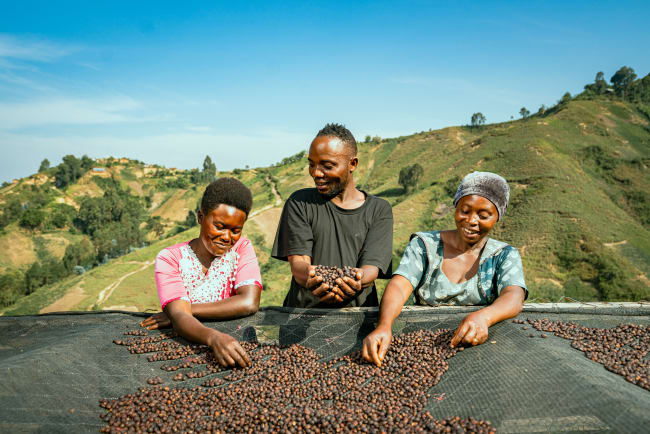
The growers behind the score
An 84+ point score doesn’t happen by accident. It requires skill, experience, and a deep understanding of the land – decisions made at every stage of the growing, harvesting, and processing cycle that determine what ends up in the cup.
At Pact, we work with some of the world’s best growers, such as:
Oscar Hernández, in Colombia, whose high-altitude farming and experimental processing produce complex, bright, and juicy lots that consistently rank among the country’s finest.
Marcus Carvalho, in Brazil, whose approach combines generational knowledge with modern sustainability to produce the rich, chocolatey profiles the country does so well.
We work directly with these growers, building long-term relationships rather than buying through commodity auctions – which means they’re paid well for exceptional work, and we know exactly where every bean comes from. We’re proud to say that we’ve now worked with both Oscar and Marcus for over a decade.